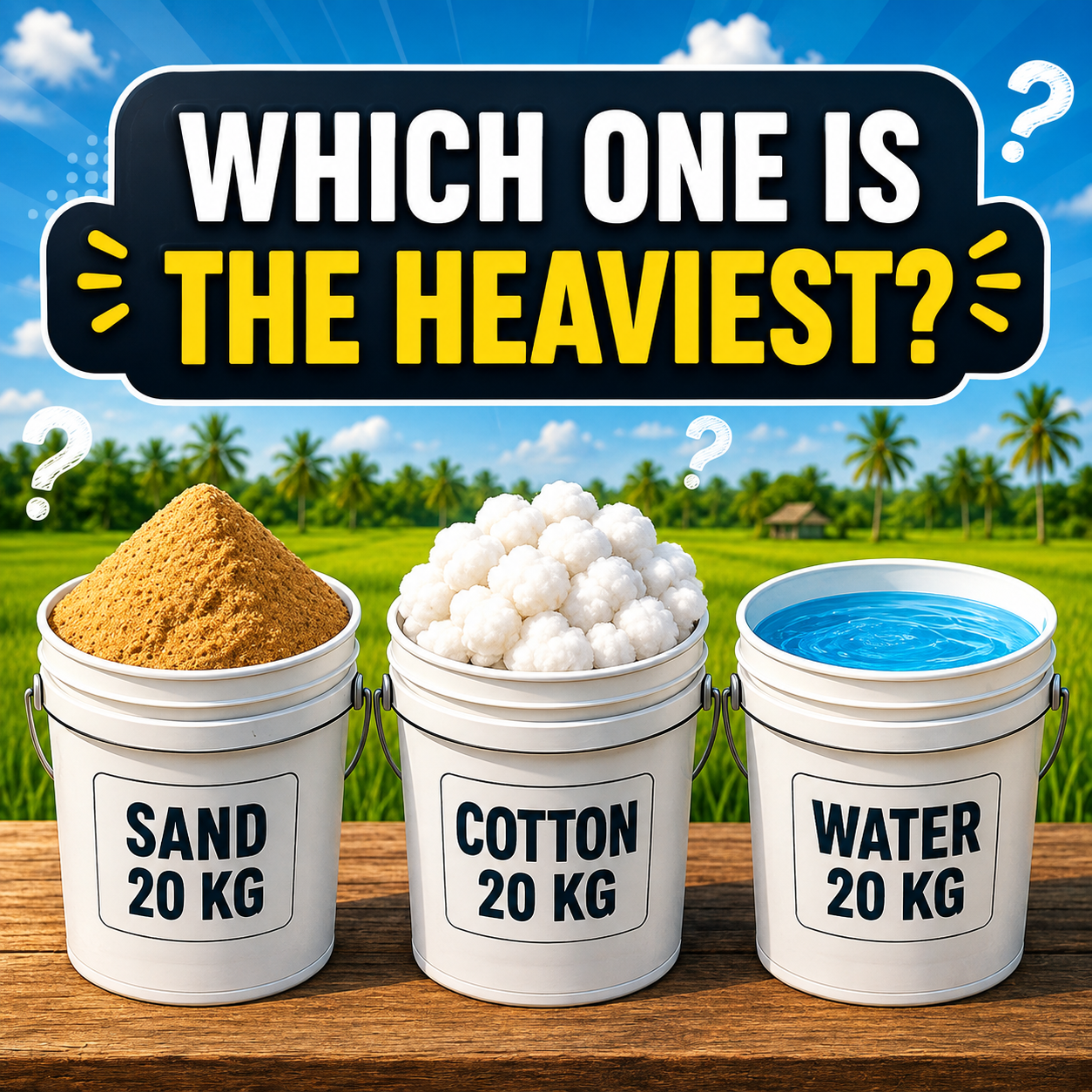
At first glance, this looks like a simple question.
There are three buckets.
One bucket is filled with sand.
One bucket is filled with cotton.
One bucket is filled with water.
And each bucket has the same label:
20 KG
Then the question asks:
Which one is the heaviest?
Most people will look at the picture and immediately say:
“Sand is the heaviest.”
And honestly, that answer feels natural.
Because sand looks heavy.
It is dense.
It is rough.
If you have ever carried a bag of sand, you know it feels like lifting a rock.
Then some people might say:
“No, water is heavier.”
Because a full bucket of water is not easy to carry either.
Anyone who has carried water from one place to another knows how quickly your arms get tired.
And almost nobody wants to choose cotton.
Because cotton looks light.
Soft.
Fluffy.
Almost weightless.
A bucket full of cotton looks like something you could lift with one finger.
But here is the trick.
The labels are not asking what looks heavier.
They are telling you the weight.
Sand: 20 kilograms
Cotton: 20 kilograms
Water: 20 kilograms
So the correct answer is:
They are all the same weight.
The sand is 20 kg.
The cotton is 20 kg.
The water is 20 kg.
None of them is heavier than the other.
They only look different because they have different density and volume.
That is where the brain gets fooled.
Sand is dense, so 20 kg of sand takes up less space.
Water is less dense than sand, so 20 kg of water takes up more space than sand.
Cotton is very light and fluffy, so 20 kg of cotton would take up a lot more space than both sand and water.
But once the weight is fixed at 20 kg, the material does not matter.
Twenty kilograms is twenty kilograms.
This is the same classic riddle as:
Which is heavier: one kilogram of iron or one kilogram of feathers?
The answer is:
They weigh the same.
But people often choose iron because iron feels heavier in real life.
That happens because our brain connects certain materials with heaviness.
Metal looks heavy.
Stone looks heavy.
Sand looks heavy.
Cotton looks light.
Feathers look light.
But weight is not about appearance.
Weight is measurement.
If two things are both measured at the same weight, then they are equal, even if one looks much bigger, softer, or lighter.
This image is a great example of how perception can fool us.
The cotton bucket looks lighter because cotton has a lot of air space inside it.
It appears bigger and fluffier, but if the total mass is 20 kg, then it weighs exactly the same as the sand and water.
The sand bucket looks heavier because sand is compact and dense.
But the label already tells us it is only 20 kg.
The water bucket may look medium-heavy, but again, it is also 20 kg.
So the real lesson is simple:
Do not judge only by appearance.
Sometimes what looks heavy is not heavier.
Sometimes what looks light can carry the same weight.
And sometimes the answer is already written in front of us, but our assumptions make us ignore it.
This question is not really about sand, cotton, and water.
It is about how quickly people make decisions based on what they see.
In life, we often do the same thing.
We look at someone smiling and assume they are fine.
We look at someone quiet and assume they are rude.
We look at someone successful and assume life is easy for them.
We look at someone struggling and assume they are weak.
But just like these buckets, the outside appearance does not always tell the full story.
A person who looks strong may be carrying emotional weight.
A person who looks soft may be stronger than anyone knows.
A person who looks fine may be silently dealing with something heavy.
That is why this simple puzzle works so well.
It makes people laugh first.
Then it makes them think.
So, if someone asks:
Which one is the heaviest?
The smart answer is:
None. They are all equally heavy because each one is 20 kg.
Sand, cotton, and water may look different, feel different, and take up different amounts of space.
But according to the labels, they weigh the same.
And that is the whole trick.
The brain sees material.
But math sees measurement.
Final Answer:
All three are the same weight: 20 kg each.