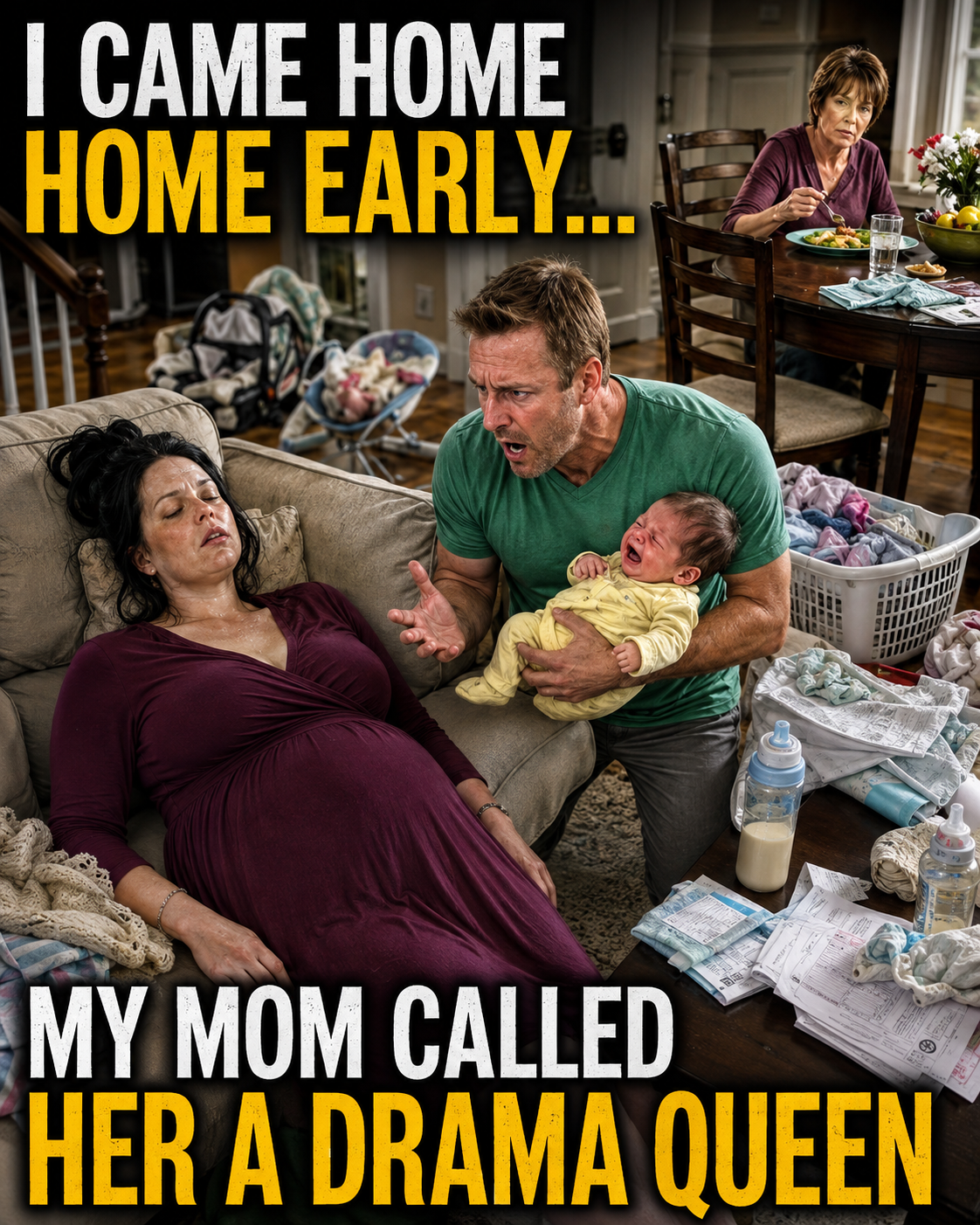
I came home early that evening because the meeting ended sooner than expected.
At first, I thought it was a blessing.
Clara had only been home from the hospital for two days after giving birth to our son, Noah, and I had hated leaving her even for a few hours.
My mother had insisted she could “help.”
She said she raised three children.
She said Clara needed an experienced woman in the house.
She said I was being overprotective.
And because I had spent my entire life confusing my mother’s confidence with wisdom, I believed her.
That was my mistake.
The first thing I heard before I even opened the front door was my newborn son crying.
Not fussing.
Not making little hungry noises.
Crying.
Hard.
Desperate.
The kind of cry that slices straight through your chest.
My hand froze on the key.
For one second, I stood there in the hallway, listening.
Then I opened the door.
The smell hit me first.
Overcooked rice.
Roasted chicken.
Formula.
Laundry.
Something burned slightly on the stove.
The house looked like someone had tried to do too much and collapsed halfway through it.
A laundry basket had tipped over in the living room.
Baby clothes were scattered across the floor.
Several bottles sat beside the sink.
Clara’s hospital discharge papers were still on the coffee table, the yellow warning sheet lying open where anyone could read it.
Call for medical help if the patient becomes dizzy, confused, feverish, extremely weak, or unable to remain awake.
Then I saw Clara.
My wife was lying across the sofa.
Her face was pale.
Too pale.
Her lips had almost no color.
One arm hung over the cushion, fingers limp, her breathing shallow and uneven.
Beside her, Noah was crying in the bassinet, his tiny body shaking with the effort.
His clothes were damp.
His face was red.
He looked like he had been crying for a long time.
And my mother was sitting at the dining table.
Eating.
Calmly.
Her plate was full.
Chicken.
Rice.
Vegetables.
A proper homemade dinner.
Not something she had made.
Something Clara had clearly been forced to make.
My mother lifted her fork, looked at Clara, and said under her breath:
“Drama queen.”
Something inside me went cold.
Not hot.
Cold.
The kind of cold that comes when your heart finally understands something your mind has been refusing to admit for years.
I crossed the room and picked up my son.
The moment Noah touched my chest, his little fingers grabbed my shirt like he had been waiting for anyone to notice him.
His onesie was wet.
His cheeks were warm.
His cry broke into hiccups as I held him close.
“It’s okay,” I whispered. “Daddy’s here.”
Then I knelt beside Clara.
“Clara?”
She did not answer.
I touched her cheek.
Her skin was cold and damp.
“Clara, sweetheart, open your eyes.”
Her eyelids fluttered.
She tried to speak, but only a breath came out.
My mother sighed behind me.
“Don’t encourage it,” she said. “Women have babies every day. I had three, and nobody treated me like glass.”
I turned slowly.
For thirty-four years, I had heard that tone.
That sharp, dismissive voice.
As a child, I heard it when I cried.
As a teenager, I heard it when I failed.
As a grown man, I heard it whenever I tried to defend someone she wanted to control.
She never yelled at first.
She did not have to.
My mother knew how to make cruelty sound like common sense.
“You made her cook?” I asked.
My voice was low.
She wiped her mouth with a napkin.
“She offered.”
Clara’s fingers moved weakly against mine.
Her lips parted.
“No,” she whispered.
One word.
One weak, broken word.
And suddenly, the entire scene made sense.
The grocery bag by the back door.
The cutting board left wet on the counter.
The pans in the sink.
The bottles half-prepared.
The laundry basket spilled in the middle of the room.
Clara had tried to take care of Noah.
Tried to clean.
Tried to cook.
Tried to satisfy my mother.
All while recovering from childbirth.
All while her body was still bleeding, healing, aching, and exhausted.
I looked at my mother again.
“You saw her like this and kept eating?”
“She needed to learn,” Mom said. “A wife and mother cannot fall apart every time life gets hard.”
My son whimpered against my shoulder.
Clara’s breathing sounded wrong.
I looked at the hospital paper again.
Dizzy.
Confused.
Extremely weak.
Unable to remain awake.
Every warning was right there.
Right in front of her.
And she had ignored all of it because, to her, compassion was weakness.
I stood.
“I’m taking my wife and my son out of this house.”
For the first time, my mother’s face changed.
Not guilt.
Not concern.
Fear.
But not for Clara.
For herself.
“You’re being ridiculous,” she said.
I pulled out my phone.
Her eyes followed my hand.
“What are you doing?”
I dialed emergency services.
Her fork stopped halfway to her mouth.
The confidence drained from her face.
That was the moment she understood this would not be handled inside the family.
This would not be twisted later.
This would not become another story where she was “just trying to help.”
The operator answered.
“What’s your emergency?”
I looked at my wife, barely conscious on the sofa.
“My wife gave birth two days ago,” I said. “She’s extremely weak, pale, barely responsive, and I need an ambulance.”
My mother stood so fast her chair scraped the floor.
“Hang up,” she hissed.
I did not even look at her.
The operator asked questions.
Was Clara breathing?
Was she bleeding heavily?
Was she feverish?
Was she able to answer?
I answered everything as clearly as I could while holding Noah against me.
Clara tried to open her eyes again.
“I’m sorry,” she whispered.
That almost broke me.
Sorry.
She was lying there half-conscious after being pushed past her limits, and she was apologizing.
I brushed her hair from her face.
“No. No, sweetheart. You don’t apologize. You did nothing wrong.”
My mother’s voice came from behind me, tight and angry.
“She is manipulating you.”
I turned then.
Really turned.
For the first time in my life, I looked at my mother without the filter of childhood.
Without excuses.
Without fear.
Without that old desperate need to believe she loved me in a way that did not hurt.
“No,” I said. “You are.”
Her face hardened.
“You’ll regret speaking to me like that.”
I almost laughed.
Not because it was funny.
Because I had been waiting my entire life for that threat to stop working.
“No,” I said quietly. “I regret letting you into my home.”
The ambulance arrived nine minutes later.
Those nine minutes felt like a lifetime.
The paramedics moved quickly.
They checked Clara’s blood pressure.
Her pulse.
Her temperature.
Her bleeding.
They asked when she last ate.
When she last drank.
When she last slept.
I looked at my mother.
She looked away.
One paramedic asked, “Has she been resting since discharge?”
Before I could answer, Clara whispered, “No.”
The room went silent.
The paramedic’s eyes moved from Clara to my mother, then to the untouched hospital instructions on the table.
No one accused her.
No one needed to.
The scene accused her for them.
As they lifted Clara onto the stretcher, Noah began crying again.
I held him close and followed.
My mother stepped in front of me.
“You are not taking my grandson away from me.”
My hand tightened around Noah.
I looked at her.
“You had him crying beside a barely conscious mother while you ate dinner.”
Her mouth opened.
Nothing came out.
“You don’t get to say ‘my grandson’ right now.”
The paramedic paused near the door, watching.
My mother lowered her voice.
“I am your mother.”
For years, that sentence had been enough.
Enough to make me forgive.
Enough to make me silent.
Enough to make me choose peace over truth.
But that night, with my wife being carried out of our home and my newborn son trembling against my chest, it finally meant something different.
“Yes,” I said. “And that makes what you did worse.”
At the hospital, they took Clara in immediately.
A nurse wrapped Noah in a clean blanket and helped me feed him.
His tiny mouth searched for the bottle, and when he finally started drinking, I felt shame burn through me.
My baby had been hungry.
My wife had been sick.
And I had left them with someone I should have known better than to trust.
A doctor later explained that Clara was severely exhausted and dehydrated, with signs that required close monitoring. They wanted to run tests and keep her under observation.
“She needed rest,” the doctor said carefully. “Not stress. Not housework. Not cooking.”
I nodded.
I could not speak.
Because every word felt like a stone in my throat.
When Clara was stable enough for visitors, I sat beside her bed with Noah asleep in my arms.
Her eyes opened slowly.
The first thing she said was, “Where is your mother?”
“Gone,” I said.
Clara’s eyes filled with tears.
“I tried to tell her I couldn’t stand.”
“I know.”
“She said if I wanted to be a good mother, I needed to stop acting weak.”
My jaw clenched.
Clara looked away.
“I thought maybe she was right.”
That was when I realized the damage was deeper than one evening.
My mother had not only exhausted her body.
She had made my wife doubt her own suffering.
I placed Noah gently in the bassinet beside the bed, then took Clara’s hand.
“Listen to me,” I said. “You just gave birth. You are healing. You are allowed to rest. You are allowed to need help. You are allowed to say no.”
Tears slipped down her face.
“And my mother,” I continued, “will never be alone with you or Noah again.”
Clara closed her eyes.
Relief moved across her face so clearly it hurt to see.
That night, while Clara slept, I called my mother.
She answered on the second ring.
Her voice was cold.
“Have you come to your senses?”
“No,” I said. “I finally found them.”
Silence.
“You are no longer welcome in our home unless Clara and I both agree.”
She scoffed.
“You’re choosing her over your own mother?”
“I’m choosing my wife and child over abuse.”
That word landed hard.
Abuse.
For years, I had avoided it.
I had called it strictness.
Personality.
Old-fashioned parenting.
High standards.
But the truth does not become smaller because you rename it.
My mother’s voice sharpened.
“How dare you call me abusive after everything I sacrificed for you?”
“You taught me to fear disappointing you more than I trusted my own feelings,” I said. “You humiliated me and called it honesty. You controlled me and called it love. And today you did it to Clara.”
“She is weak.”
“No,” I said. “She is recovering. There is a difference.”
“She will turn you against me.”
“You did that yourself.”
For the first time in my life, my mother had no immediate answer.
So I gave her the boundary before she could find one.
“You will not call Clara. You will not visit the house. You will not demand access to Noah. If you want a relationship with us, you will apologize, get help, and respect every boundary we set.”
She laughed bitterly.
“You sound ridiculous.”
“Maybe,” I said. “But I sound free.”
Then I hung up.
My hands were shaking.
Not from fear.
From years of finally ending.
The next few weeks were not easy.
Clara needed time to recover.
Noah needed constant care.
I took leave from work.
We accepted help from people who actually helped.
My sister brought meals and cried when I told her what happened.
Our neighbor folded laundry.
Clara’s best friend stayed overnight twice so I could sleep.
No one demanded a cooked dinner.
No one called Clara lazy.
No one stepped over a crying baby to finish a plate of chicken.
Real help felt different.
Gentle.
Quiet.
Useful.
My mother sent messages for days.
First angry.
Then dramatic.
Then wounded.
Then sweet.
That was her pattern.
Attack.
Deny.
Cry.
Charm.
Repeat.
But this time, I did not open the door.
One afternoon, she wrote:
After all I’ve done for you, this is how you repay me?
I looked at Noah sleeping in his crib.
Then at Clara resting on the sofa, color slowly returning to her face.
I typed back:
I’m not repaying you. I’m protecting them.
Then I blocked her for a while.
Not forever.
Maybe one day there would be a conversation.
Maybe one day there would be accountability.
Maybe one day she would understand.
But healing does not require immediate access.
Blood does not cancel boundaries.
And motherhood does not give someone permission to be cruel.
Months later, Clara told me something I will never forget.
She was rocking Noah by the window, the afternoon light on her face.
She looked stronger.
Still tired, but herself again.
“I thought you might defend her,” she said quietly.
The words hurt.
Because some part of her had expected me to choose the woman who raised me over the woman I married.
And the worst part was, before that day, I might have tried to keep peace.
I might have said Mom meant well.
I might have asked Clara to understand.
I might have been wrong.
“I’m sorry,” I said.
She looked at me.
“I don’t just mean that day.”
I nodded.
“I know.”
Because the truth was, my mother had been walking through the edges of our marriage for years.
Small comments.
Small criticisms.
Small tests of control.
And I had ignored them because I did not want to face the bigger truth.
That the woman who raised me had also wounded me.
That love and cruelty can come from the same person.
And that protecting your family sometimes means standing up to the first family you ever knew.
I sat beside Clara and took Noah’s tiny hand.
“I should have seen it sooner,” I said.
Clara leaned against me.
“You saw it when it mattered most.”
But I knew it had mattered before too.
It mattered every time Clara went quiet after my mother visited.
Every time my mother criticized her cooking, her cleaning, her parenting, her body, her emotions.
Every time I said, “That’s just how Mom is.”
That sentence protects the wrong person.
So now I say something else.
That is not okay.
Months passed.
Our home became peaceful.
Not perfect.
There were sleepless nights.
Laundry piles.
Bottle disasters.
Diaper explosions.
Arguments caused by exhaustion.
But there was no cruelty disguised as advice.
No woman eating dinner while another woman collapsed.
No crying baby ignored to prove a point.
One evening, Clara fell asleep on the sofa with Noah curled safely against my chest.
The living room was messy.
Toys on the floor.
Burp cloths everywhere.
A half-empty cup of coffee on the table.
Dinner was just toast and scrambled eggs.
And yet, the house felt warmer than it ever had when my mother was there.
Because a proper home is not one where everything is spotless.
A proper home is one where people are safe.
That day I came home early, I thought I was walking into a family disagreement.
I was not.
I was walking into the moment my old life ended.
The moment I stopped excusing cruelty because it came from my mother.
The moment I understood that strength without compassion is not strength.
It is hardness.
And hardness can break everyone around it.
My wife survived that day.
My son was okay.
But something else did not survive.
My mother’s control over me.
And for the first time in my life, I did not mourn it.