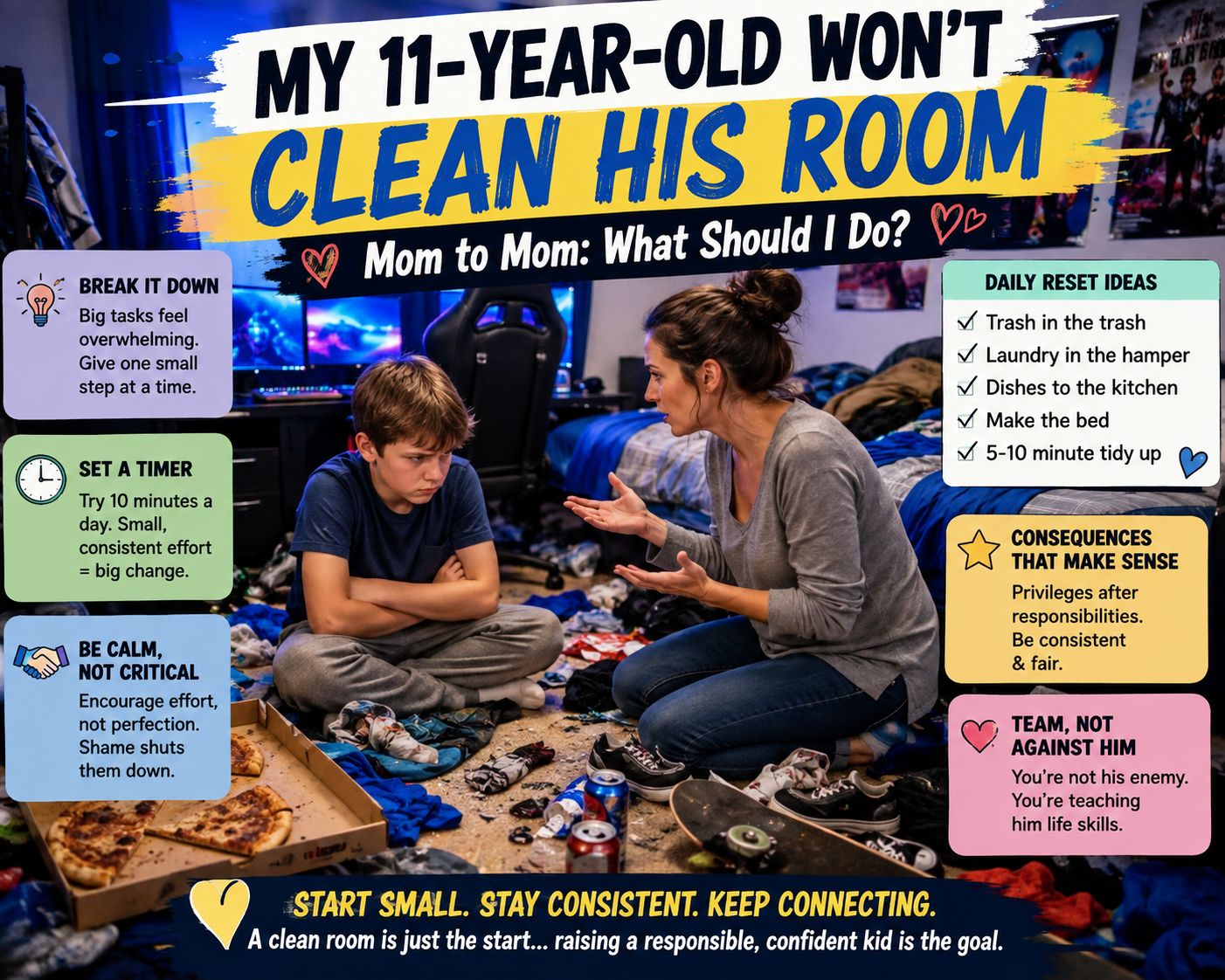
Mom to mom, I need honest advice.
Because I am tired.
Not “I had a long day” tired.
I mean the kind of tired where one simple sentence turns into a battle every single night.
“Please clean your room.”
That is all I say.
And somehow, those four words can change the entire mood of the house.
My son is eleven and a half.
Almost twelve.
Old enough to understand responsibility.
Old enough to know trash does not belong on the floor.
Old enough to know clean clothes and dirty clothes should not live in the same pile.
Old enough to know empty cans, snack wrappers, socks, game controllers, school papers, and random pieces of clothing should not be scattered across the room like a tornado passed through.
But every time I ask him to clean it, he shuts down.
Sometimes he gets angry.
Sometimes he says, “I’ll do it later.”
Sometimes he says, “It’s my room.”
Sometimes he acts like I am asking him to rebuild the entire house with his bare hands.
And sometimes, he just stands there looking overwhelmed, like he genuinely has no idea where to begin.
That is the part that confuses me.
Because part of me wants to be firm.
I want to say, “No. Enough. You are old enough to clean your room.”
But another part of me looks at the mess and wonders if maybe he is not being lazy.
Maybe he is overwhelmed.
Maybe when I see a messy room, I see laundry, trash, dishes, and clutter.
But when he sees it, he sees one giant impossible problem.
And instead of starting, he explodes.
Or avoids.
Or argues.
Or gives up before he even begins.
Still, I am exhausted.
Because every night, it becomes a fight.
I remind him after school.
He ignores me.
I remind him after dinner.
He gets annoyed.
I remind him before bed.
Now we are both angry.
Then I raise my voice.
He raises his.
I threaten to take things away.
He says he does not care.
Then I feel guilty.
Then nothing gets cleaned.
And the next day, the room is even worse.
It has become a cycle.
A messy room.
A frustrated mom.
An overwhelmed kid.
A fight.
No progress.
More resentment.
And honestly, I do not want our relationship to become centered around the state of his bedroom.
I do not want him to remember childhood as me standing in the doorway pointing at clothes on the floor.
But I also do not want to raise a child who thinks someone else will always clean up after him.
So what do I do?
First, I think I need to stop saying, “Clean your room.”
Because that sounds simple to adults, but to some kids, it is too big.
It is not one task.
It is ten tasks hiding inside one sentence.
Pick up trash.
Put dirty clothes in the hamper.
Fold clean clothes.
Put shoes away.
Bring dishes to the kitchen.
Clear the desk.
Make the bed.
Organize toys or games.
Vacuum.
Find the mystery smell.
That is a lot.
So maybe instead of saying, “Clean your room,” I need to break it down.
One instruction at a time.
“First, grab a trash bag and pick up only trash.”
That is it.
Not clothes.
Not toys.
Not the bed.
Just trash.
Then when that is done:
“Now put all dirty clothes in the hamper.”
Then:
“Now bring dishes and cups to the kitchen.”
Then:
“Now put clean clothes on the bed.”
Then:
“Now we fold them.”
Maybe he needs a checklist.
Not a lecture.
Maybe he needs the room divided into small missions instead of one impossible mountain.
Second, I think I need to choose the right time.
Because asking him to clean when he is tired, hungry, overstimulated, or already upset is probably setting both of us up to fail.
After a full school day, homework, screens, noise, and expectations, maybe his brain is done.
That does not mean he gets no responsibility.
It just means timing matters.
Maybe we set a fixed clean-up time.
Not random.
Not when I finally snap.
Something predictable.
Every day at 6:30, ten minutes.
Not two hours.
Not until the whole room is perfect.
Just ten minutes with a timer.
Because a child may resist “clean until it’s done.”
But ten minutes feels possible.
And if we do that every day, maybe it never gets this bad again.
Third, I need to stop making it personal.
When I say, “Your room is disgusting,” he hears, “You are disgusting.”
When I say, “You never help,” he hears, “You are lazy.”
When I say, “I’m sick of this,” he hears anger before he hears the instruction.
That does not mean I am wrong to be frustrated.
I am human.
But if my goal is cooperation, shame probably will not work.
Maybe I need to say:
“This room has gotten too big to handle. Let’s reset it.”
Not:
“Look what you did.”
Because shame makes kids defensive.
A plan gives them a way forward.
Fourth, consequences still matter.
Because compassion does not mean no rules.
If his room is full of trash and laundry, that cannot just be ignored.
But the consequence should connect to the problem.
If he cannot keep track of his stuff, maybe fewer items belong in the room.
If dishes are left inside, no food goes into the bedroom.
If clothes are everywhere, we reduce the amount of clothes available at once.
If gaming or screens are part of the mess cycle, screens happen after the ten-minute reset, not before.
Not as a screaming punishment.
Just as a house rule.
“Responsibilities first, privileges after.”
Calm.
Consistent.
No debate.
Fifth, maybe I need to help him start without doing it all for him.
That is hard.
Because sometimes I go in there and just want to clean it myself.
It would be faster.
It would be easier.
It would be done right.
But then he learns nothing.
On the other hand, if I stand at the door and demand he figure it out alone, he may shut down completely.
So maybe the middle ground is:
“I will sit here for the first five minutes and help you decide what comes first. I will not clean it for you, but I will help you start.”
Sometimes kids do better with body doubling.
Meaning someone nearby, calmly present, helping them stay focused without doing the task for them.
Not hovering.
Not criticizing.
Just being there.
Sixth, I need to make the room easier to maintain.
Maybe the system is too complicated.
Maybe he does not need perfect drawers.
Maybe he needs simple bins.
Trash can beside the desk.
Laundry hamper where clothes naturally land.
One basket for random items.
One shelf for games.
Hooks instead of hangers.
Labels if needed.
Because if the system requires adult-level organization, he may fail every time.
A kid’s room does not need to look like a magazine.
It needs to be safe, hygienic, and manageable.
Seventh, I need to ask him what is happening when we are not in the middle of a fight.
Not when the room is a disaster.
Not when I am angry.
Maybe in the car.
Maybe while eating.
Maybe at bedtime.
Something like:
“I notice cleaning your room feels really hard for you. What part feels the worst?”
Then listen.
He may say it is boring.
He may say he does not care.
He may say he does not know where to start.
He may say he gets mad because he feels judged.
He may not have the perfect answer.
But at least the conversation changes from “you versus me” to “us versus the problem.”
That matters.
Because the goal is not just a clean room.
The goal is teaching him how to handle overwhelming tasks.
That is a life skill.
One day it will be homework.
A job.
Bills.
A kitchen.
A car.
A family.
He needs to learn that when something feels too big, you do not just avoid it or explode.
You break it down.
You start small.
You do one thing.
Then the next.
Then the next.
So maybe the plan should be simple.
Tonight, I do not demand the whole room.
Tonight, I say:
“Here is a trash bag. We are doing trash only for ten minutes.”
I set a timer.
No yelling.
No long speech.
No insults.
No arguing.
Just:
“Trash first.”
When the timer ends, we stop.
Even if it is not perfect.
Then tomorrow:
“Laundry only.”
The next day:
“Desk only.”
And once it is reset, we keep it from exploding again with a daily ten-minute clean-up.
Maybe Saturday becomes reset day.
Maybe every night before screens end, he does three things:
Trash in the trash.
Laundry in the hamper.
Dishes to the kitchen.
That alone would change everything.
And if he refuses?
Then screens, gaming, or extra privileges pause until the basic reset is done.
Not because I am being mean.
Because a shared home requires shared responsibility.
But I also have to remember this:
He is not an adult.
He is still learning.
His anger may be disrespect, yes.
But it may also be frustration.
His refusal may be defiance, yes.
But it may also be overwhelm.
And my job is not to excuse everything.
My job is to teach him without destroying our connection.
So to any mom dealing with this, you are not alone.
A messy room can feel like a small thing until it becomes a daily war.
And when you are tired, it is easy to feel like you are failing.
But maybe this is not a failure.
Maybe this is a skill gap.
Maybe our kids need less yelling and more structure.
Less “clean this disaster” and more “start with the trash.”
Less shame and more systems.
Less fighting and more consistency.
The room did not get this way in one day.
It probably will not change in one day either.
But one bag of trash is a start.
One hamper of clothes is a start.
One calm ten-minute clean-up is a start.
And sometimes, as moms, we have to stop trying to win the fight and start building a routine that makes the fight unnecessary.
Because the real goal is not a perfect bedroom.
The real goal is raising a child who learns responsibility, self-control, and how to take care of his space without feeling like the mess is bigger than he is.