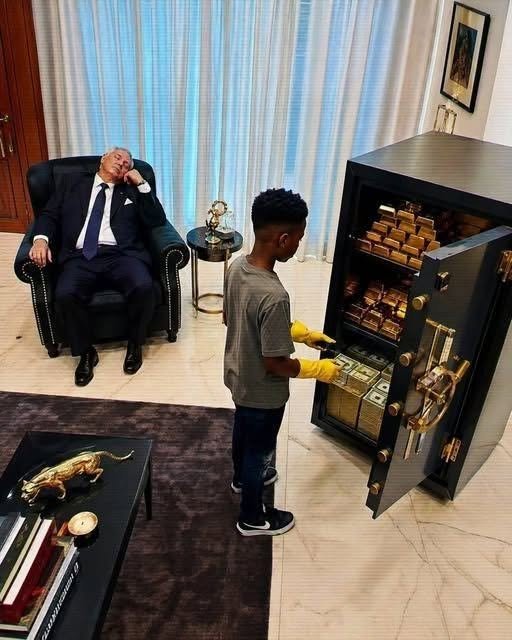
The heavy silence of the library stretched on, punctuated only by the rhythmic clicking of the grandfather clock and the lash of rain against the glass.
Malcolm waited. He knew the allure of wealth was a magnet too strong for most adults to resist, let alone a destitute seven-year-old child. From beneath his heavy eyelids, maintaining the illusion of deep sleep, he narrowed his vision to a tiny slit.
Milo sat on the edge of a footstool in the corner, his small hands clasped in his lap. His shoes were worn, the fabric of his trousers frayed at the knees, but he sat as straight as a soldier. For a long time, the boy simply stared at his own shoes, obeying his mother’s command with a discipline that surprised the old billionaire.
But then, Milo’s eyes drifted. They scanned the towering bookshelves, the glinting gold leaf on the book spines, and finally, they landed on the mahogany table.
There it lay. The open envelope. The crisp, green edges of the hundred-dollar bills caught the firelight.
Malcolm’s internal cynical smile widened. Here it comes, he thought. The curiosity. The temptation. The theft.
Milo stood up. His movements were fluid and completely silent, like a shadow gliding across the thick Persian rug. Step by step, the boy closed the distance between the corner and the armchair. Malcolm braced himself, ready to snap his eyes open, grab the child’s wrist, and deliver the lecture on honesty he had delivered to so many others before exposing them.
The boy reached the table. He looked down at the money. Five thousand dollars—enough to pay off his mother’s debts, buy him endless toys, and secure them a safe place to live for months. Milo reached his hand out toward the envelope.
Malcolm’s muscles tensed, ready to spring the trap.
But Milo didn’t touch the cash.
Instead, the boy gently reached past the envelope and picked up a heavy silver paperweight shaped like a roaring lion. Malcolm watched, utterly perplexed, as Milo didn’t pocket anything. Instead, the child walked around to the side of the armchair.
The old man’s frail frame was slightly slumped, and because of his posture, a heavy, dark green wool blanket had slipped off his lap, pooling onto the cold hardwood floor beside the rug.
Milo set the silver paperweight quietly onto the table, then knelt down. With immense care, trying his absolute best not to make a sound, the seven-year-old lifted the heavy blanket. He shook it out gently, then draped it over Malcolm’s exposed, trembling legs. He pulled it up to the old man’s chest, tucking the edges softly around Malcolm’s shoulders to shield him from the draft coming off the rainy windows.
Malcolm froze, fighting with every ounce of his willpower to keep his breathing steady. His mind reeled. The boy wasn’t looking at the money. He was looking at him.
Milo stepped back, surveying his work. He noticed the open envelope again. He looked at the cash, then looked at Malcolm’s face. A look of deep worry crossed the child’s young features.
“You shouldn’t leave your windows open, Mr. Greyford,” Milo whispered to the silent room, his voice barely a breath. “And you shouldn’t leave your door unlocked. People might take your warmth.”
Then, using his tiny index finger, Milo didn’t take a bill—he simply pushed the exposed money deeper into the envelope, folded the paper flap down tightly to hide the cash from view, and placed the heavy silver lion paperweight squarely on top of it so the draft wouldn’t blow it away.
Without a backward glance at the fortune, Milo retreated to his corner, sat back down on the footstool, and folded his hands in his lap, waiting patiently for his mother to return.
Behind his closed eyes, the fierce, cynical heart of Malcolm Greyford cracked open. For decades, he had tested humanity and watched it fail. He had built walls of stone and gold, convinced that kindness was a myth and greed was the only truth. Yet here, in the quiet of his library, a penniless child whose mother was one mistake away from homelessness had seen a vulnerable old man, ignored a fortune, and chosen to give him warmth instead.
Malcolm remained still, but for the first time in twenty years, a single, silent tear slipped down his weathered cheek, lost in the shadows of the firelight.