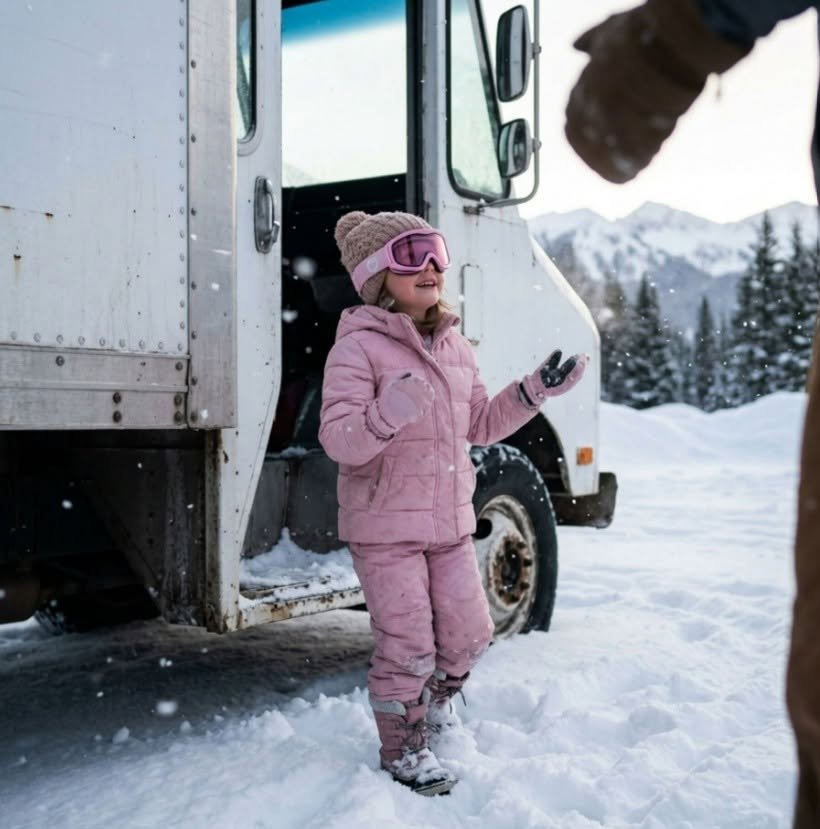
PART 2
I was sitting in my truck outside a delivery stop. “What happened?”
Ashton sighed like the cancellation hurt him more than anyone else.
“Cabin fees went up. Lift tickets are insane. Mom and Dad are stressed. It’s just not the right year.”
I stared through the windshield at the gray warehouse in front of me.
“What about the deposit?”
“We’ll figure it out later.”
“Zoe’s been counting days since September.”
“I know,” he said, but he said it too quickly.
Like he didn’t know at all.
“She bought goggles.”
“Kids get over things,” Ashton replied.
That sentence stayed with me.
Kids get over things.
Maybe some kids did. Kids who had new distractions, vacations, full closets, grandparents who showed up, cousins who didn’t laugh when they got excited about something.
But Zoe wasn’t that kind of kid.
Zoe remembered everything.
She remembered the one time my mother promised to take her to the aquarium and canceled because my niece Ava had a dance recital. She remembered when Ashton’s wife told her to “stop hovering around the snack table” at Thanksgiving. She remembered birthdays where her cousins opened piles of gifts while she got a card with twenty dollars inside because “money was easier.”
Still, she kept hoping.
That was what broke me most.
She kept giving people chances they had not earned.
When I got home that night, the pink ski goggles were on the counter beside the paper towel roll.
Zoe was sitting at the kitchen table doing math homework, her hair pulled into two uneven braids because I had tried my best before school.
“Uncle Ashton called?” she asked.
I froze.
She already knew.
I sat across from her.
“Yeah, baby.”
Her pencil stopped moving.
“It’s canceled?”
I nodded.
For a second, she looked down at her worksheet.
Then she forced a smile so adult it made my chest ache.
“That’s okay. Snow will still be there another time.”
I wanted to tell her not to be brave.
Not for me.
Not at eight years old.
But I could not make the trip happen. I had already paid my share to Ashton months earlier, little by little, because that was how money worked in my life. Rent first. Groceries next. Gas. School shoes. Then anything joyful, if there was anything left.
So I kissed the top of her head and said, “I’m sorry, Zo.”
She shrugged.
“It’s okay, Dad.”
But that night, after I thought she was asleep, I found her sitting on the floor beside her bed with the goggles in her lap.
She wasn’t crying loudly.
Just quietly wiping her cheeks with her sleeve.
I stood in the hallway and hated my brother.
For three weeks, the goggles stayed on the kitchen counter.
I should have put them away, but Zoe asked me not to.
“I like looking at them,” she said.
So there they sat.
Pink.
Shiny.
Unused.
A tiny monument to a promise somebody else had broken.
Then, on a Saturday morning, while Zoe was watching cartoons and I was making toast, my phone buzzed.
My cousin Melanie had tagged Ashton in a post.
I almost scrolled past it.
Then I saw snow.
Bright white slopes.
A wooden cabin.
A firepit.
My parents smiling in thick coats.
Ashton’s kids holding ski poles.
Ava wearing a white helmet with glitter stickers.
And there, standing in the center of the photo with a champagne glass lifted, was Ashton.
The caption read:
Annual family ski weekend! Nothing better than tradition.
My hands went cold.
The toast burned in the toaster.
I clicked through the photos.
There were more.
My mother with hot cocoa.
My father helping Ava on bunny slopes.
Ashton’s wife laughing beside a rental SUV.
My cousins.
My aunt.
Everyone.
Everyone except me and Zoe.
The trip had not been canceled.
We had been uninvited.
I stood in my kitchen with the smell of burned toast filling the air and the pink goggles sitting six inches from my hand.
Zoe came in wearing her fuzzy socks.
“Dad? Is something burning?”
I locked my phone and turned around too fast.
“Toast.”
She looked at my face.
“What happened?”
“Nothing.”
She looked at the goggles.
Then at my phone.
Then back at me.
Zoe was quiet, not unaware.
“Did they go skiing?”
I could have lied.
God help me, I wanted to.
But I was tired of teaching my daughter to accept lies just because the truth hurt adults.
I slowly handed her the phone.
She looked at the photos without speaking.
One.
Then another.
Then another.
When she reached the picture of Ava wearing a pink ski jacket, her mouth trembled.
“They said it was canceled.”
“I know.”
“They went without us?”
I nodded.
Her fingers tightened around the phone.
“Was it because I asked too many questions about snow?”
I dropped to my knees in front of her.
“No. No, baby. This was not because of you.”
“Then why?”
I had no good answer.
Because my brother was ashamed of my old truck and my discount boots.
Because his wife once said Zoe was “sweet but clingy.”
Because my parents liked pictures better when everyone in them looked expensive.
Because some families do not exclude you loudly; they just call it convenience until you finally notice the empty chair was planned.
I took the phone back.
“Because they made a selfish choice.”
Zoe looked toward the counter.
“Can I put the goggles away now?”
That broke me more than any crying would have.
I nodded.
She took them from the counter and carried them to her room.
I stood alone in the kitchen while my phone began buzzing.
Ashton.
I didn’t answer.
Then my mother.
Then Ashton again.
Then a text.
Don’t make this into a thing. We were going to explain.
I stared at the message.
Then I typed:
You told me the trip was canceled. You took my money. You lied to my daughter.
His reply came fast.
We didn’t take your money. We used it toward the cabin. Things were complicated.
I laughed once, so hard it scared me.
Used it toward the cabin.
My overtime.
My skipped lunches.
The envelope of cash I had handed him in October while Zoe stood beside me grinning because she thought we were officially going.
They had used my money to help pay for the trip they cut us out of.
I called him then.
He answered with a sigh.
“Listen, before you start—”
“Did you use my money?”
Silence.
“Ashton.”
“It was already part of the group payment.”
“You told me it was canceled.”
“Because I knew you’d make it awkward.”
My vision blurred.
“I would make it awkward?”
“You always act like people are judging you.”
“Because you are.”
He scoffed.
“Nobody wanted drama on vacation. Zoe gets emotional. You get defensive. Emily thought maybe it would be better if this year was just easier.”
Emily.
His wife.
Of course.
“And my money made it easier?”
He said nothing.
I looked toward Zoe’s bedroom door.
“You’re going to send it back today.”
“I can’t just—”
“Today.”
“Don’t threaten me.”
“I’m not threatening you. I’m documenting theft.”
He went quiet.
“You would call the police over a family misunderstanding?”
“There it is,” I said.
“What?”
“The word family. You always remember it when you need protection, never when my daughter needs kindness.”
He hung up.
Five minutes later, my mother called again.
This time I answered.
“Why are you upsetting everyone?” she demanded.
I looked at the burned toast in the sink.
“Good morning to you too.”
“Ashton says you’re accusing him of stealing.”
“He lied, excluded my daughter, and kept the money I paid for the trip.”
Mom lowered her voice.
“Emily felt the trip would be less stressful without you two this year.”
Without you two.
She said it so naturally.
Like Zoe and I were a weather problem.
“And you agreed?”
“She has three children to manage. Your situation is different.”
“My situation?”
“You know what I mean. Money is tight for you. Skiing is expensive. We didn’t want you feeling uncomfortable.”
I closed my eyes.
They had stolen from me and called it mercy.
“Zoe saw the photos.”
A pause.
Then Mom said, “Why would you show her that?”
I almost smiled.
Not because anything was funny.
Because somehow, in her mind, the cruelty wasn’t the lie.
It was my daughter discovering it.
“I didn’t post the pictures, Mom.”
“She’s young. She’ll get over it.”
There it was again.
Kids get over things.
“No,” I said quietly. “She’ll remember.”
Mom sighed.
“You’re being dramatic.”
I looked toward Zoe’s room.
At the closed door.
At the child behind it learning exactly where she stood in her own family.
“No,” I said. “I’m being her father.”
Then I hung up.
That afternoon, I did three things.
First, I sent Ashton a written request for repayment by Friday.
Second, I saved every message.
Third, I called the resort.
The woman on the phone was kind but cautious until I explained I had contributed payment for a family cabin and needed copies of any receipts under my name.
“My name might not be on the booking,” I said. “But I have payment messages.”
She put me on hold.
When she came back, her voice had changed.
“Sir, there is a note on the reservation.”
“What kind of note?”
“It says two guests were removed from the final occupancy list.”
My hand tightened around the phone.
“Names?”
A pause.
Then gently, “You and Zoe.”
“Who removed us?”
“I can’t provide full account details without authorization, but the change was made by the primary organizer.”
Ashton.
Of course.
“Can you email confirmation that our names were removed?”
“I can confirm only your own guest status.”
“That’s enough.”
The email arrived twenty minutes later.
It showed that me and Zoe had been listed originally.
Then removed.
Not canceled.
Removed.
I forwarded it to Ashton with one sentence.
Friday.
The money arrived Thursday night.
Not from Ashton.
From my father.
No message.
Just the exact amount I had paid.
Somehow that made me angrier.
Because Dad had not called to apologize.
He had simply paid to make the problem disappear.
Like I was a bill.
Like Zoe’s heartbreak was an invoice.
The next morning, I took Zoe to breakfast before school.
A small diner near my route where the pancakes came out too big and the waitress called everyone honey.
Zoe wore her purple hoodie and stared into her orange juice.
“I don’t want to go to Grandma’s birthday next month,” she said.
I set down my coffee.
“Okay.”
Her eyes lifted.
“Okay?”
“Yes.”
“You’re not going to say we have to because they’re family?”
“No.”
She looked confused.
“But you always say that.”
I swallowed.
“I was wrong.”
Her lip trembled.
“I don’t like feeling like they don’t want me.”
I reached across the table and took her hand.
“Then I won’t keep taking you places where people make you feel unwanted.”
She started crying then.
The waitress came over with pancakes, saw her face, and quietly placed extra whipped cream on the side without saying a word.
Kindness, I learned that morning, does not always come from the people who share your blood.
Sometimes it comes from a woman in a diner who notices a child needs sweetness and gives it freely.
For two months, we did not see my family.
My mother called it “punishment.”
Ashton called it “overreacting.”
Emily sent one text that said, Hope you’re happy making everyone uncomfortable.
I did not answer.
Because I was happy.
Not all the time.
Not completely.
But there was peace in our apartment.
No last-minute requests.
No being compared to Ashton’s family.
No watching Zoe try to earn attention from people who had already decided she was extra.
Then one evening, my father came to my door.
He stood there in his work jacket, older than I remembered, holding an envelope.
“Can we talk?”
I almost said no.
Then I saw his face.
Not angry.
Ashamed.
I stepped into the hallway but did not invite him in.
He noticed.
Good.
“I’m sorry,” he said.
I waited.
He looked down.
“I knew they went without you.”
My chest tightened.
“And you said nothing.”
“I told myself Ashton had his reasons.”
“Zoe is eight.”
“I know.”
“No, Dad. I don’t think you do.”
His eyes filled.
“I saw her goggles in your kitchen last time I came by.”
That surprised me.
He had noticed.
He just had not cared enough then.
“She was excited,” he said quietly.
“She was.”
He held out the envelope.
“What’s that?”
“Money for a snow weekend. Just you and Zoe.”
I did not take it.
His face fell.
“I’m trying to fix it.”
“You can’t fix this with money.”
“I know.”
“Do you?”
He looked toward my apartment door.
“Is she home?”
“Yes.”
“Can I apologize to her?”
I thought about it.
Then I opened the door a few inches.
“Zoe,” I called softly. “Grandpa is here. He wants to apologize. You don’t have to come out.”
For a moment, nothing happened.
Then Zoe appeared in the hallway, holding her stuffed penguin.
My father crouched slowly.