Part 2
The first thing that struck me was how calm they were.
Not emotionless.
Not cold.
Calm.
There is a difference.
Ava, the oldest, dropped to her knees beside Grant and placed two fingers against his neck.
“Pulse is weak,” she said, loud enough for the others to hear. “Owen, timer.”
A boy with glasses pulled a small stopwatch from the red emergency box and clicked it.
“Started.”
“Caleb, call 911.”
“Already dialing.”
“Mia, unlock the front door and wait outside for paramedics.”
“Going.”
“Jack, medications.”
“Got them.”
“Sophie, Eli, sit on the porch steps. Hold hands. No running.”
The two youngest children immediately moved toward the porch, though Eli’s little chin was trembling.
Through the fence, I stood frozen with one hand on the wooden board, my heart pounding so hard I could hear it in my ears.
Grant Holloway was lying on the patio, his big frame completely still, one arm bent awkwardly beside him. The man who had seemed unbreakable from a distance suddenly looked frighteningly human.
Ava leaned close to his face.
“Dad? Dad, if you can hear me, squeeze my hand.”
Nothing.
She swallowed.
Just once.
Then her voice sharpened again.
“Caleb, tell them he collapsed at 3:42 p.m. He was conscious this morning. He has the blue folder. Possible internal bleeding. History of liver failure.”
Liver failure.
The words hit me like a punch.
Luke came running from behind me.
“What happened?”
“Grant collapsed,” I said. “The kids are handling it.”
He looked through the fence and went pale.
“Should we go over?”
Before I could answer, Mia appeared at the side gate. She could not have been more than ten.
She looked at me through the fence.
“Mrs. Carter?”
I blinked.
She knew my name.
“Yes?”
Her voice shook, but she kept it steady.
“Ava says if you’re watching, please come through the gate. We may need an adult witness.”
Adult witness.
Not helper.
Not rescuer.
Witness.
I ran.
Luke followed me around the fence and into Grant’s backyard.
The moment I stepped through the gate, I saw the entire emergency plan unfolding like choreography.
The red box was open on the patio table.
Inside were labeled folders, medication bottles, laminated instruction cards, gloves, gauze, bottled water, phone chargers, and a small envelope marked:
IF DAD COLLAPSES
My stomach turned.
These children had not been trained for an imaginary disaster.
They had been trained for this exact moment.
Ava looked up at me.
She was sixteen, but in that second, her eyes looked both too young and too old.
“Can you confirm the time for 911?” she asked.
I nodded quickly.
“About 3:42. I heard him fall.”
“Thank you.”
She handed me a laminated card.
“If I get overwhelmed, read this to the operator.”
“I can talk to them now,” I said gently.
Caleb, a tall fourteen-year-old, looked at me without lowering the phone.
“I have them.”
And he did.
His voice was steady.
“Yes, my father collapsed. He is breathing but unresponsive. Address is 1842 Willow Creek Drive. He has end-stage liver disease. His medical folder is ready. No, we are not moving him. Yes, the front door is unlocked. Yes, someone is waiting outside.”
End-stage.
Not sick.
Not weak.
End-stage.
Luke’s hand found mine.
I could feel him staring at Grant with the same horror I felt.
All those mornings.
The bell.
The chores.
The strict routines.
The emergency drills.
We had thought Grant was harsh.
We had wondered if those children were being raised without softness.
But now I understood.
He had been teaching them how to survive losing him.
Ava pressed her hand to Grant’s chest.
“Still breathing.”
Owen called out, “Two minutes.”
Jack, maybe nine years old, came running with the blue medical folder clutched to his chest.
He tripped halfway across the patio, caught himself, and kept going.
No tears.
No panic.
Just duty.
That hurt more than if he had broken down.
Ava took the folder and opened it to the first page.
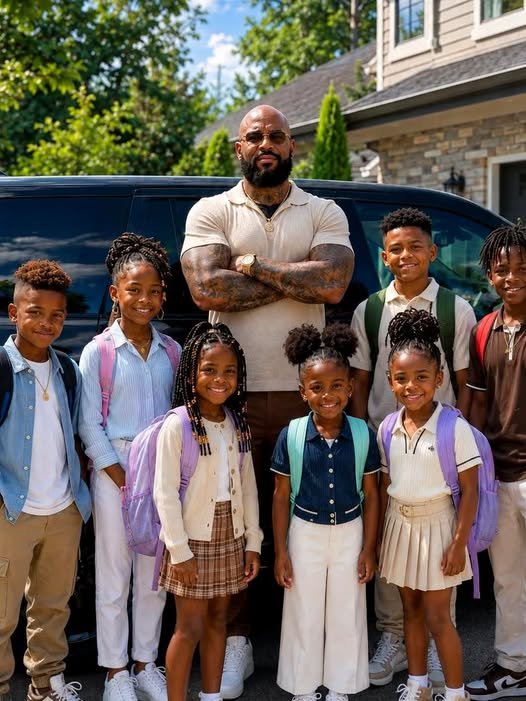
On top was a photograph of Grant with all seven children. He stood behind them with his arms crossed, looking serious as always.
Beneath the photo, in bold letters, it said:
MY CHILDREN ARE NOT UNSUPERVISED. THEY ARE TRAINED. PLEASE DO NOT SEPARATE THEM UNLESS ABSOLUTELY NECESSARY.
My throat closed.
Below that were seven names.
Birthdates.
Allergies.
School information.
Emergency contacts.
Medical insurance.
Guardianship papers.
I saw the name at the bottom.
Primary temporary guardian: Ava Holloway, pending arrival of legal guardian, Dr. Naomi Brooks.
Ava.
Sixteen years old.
Her father had prepared her to hold a family together until another adult arrived.
The sirens came six minutes later.
Mia was waiting exactly where she had been told to wait, standing at the front of the house with both arms raised.
“This way!” she shouted.
Two paramedics rushed through the gate.
Ava moved back but did not disappear.
“This is Grant Holloway,” she said. “Forty-two years old. Liver disease. He refused transport last week. He collapsed seven minutes ago. He takes these medications. He is allergic to penicillin. His latest labs are in the blue folder.”
One paramedic paused for half a second, surprised.
Then he took the folder.
“Good work.”
Ava nodded, but her mouth trembled.
Only then did I see how hard she was fighting not to fall apart.
Grant was loaded onto the stretcher.
As they strapped him in, Eli, the youngest, broke free from Sophie’s hand and ran toward him.
“Daddy!”
The whole backyard froze.
Grant did not respond.
Eli reached for his father’s hand, but the paramedic blocked him gently.
“Buddy, we need to take care of him.”
Eli’s face crumpled.
Ava crossed the patio in two steps and wrapped him in her arms.
“Red Plan,” she whispered into his hair.
Eli sobbed.
“Red Plan means stay together.”
“I know,” Ava said, and now her own tears finally spilled. “I know, baby.”
The ambulance doors closed.
For one terrible second, all seven children stood in a cluster on the driveway, staring after the vehicle as if their entire world had just been carried away with flashing lights.
Then Ava wiped her face with both hands.
“Everyone inside. Shoes on. Hospital bags by the door.”
I touched her shoulder carefully.
“Ava, I can drive some of you.”
She looked at me like she wanted to say no automatically.
Like Grant had taught them not to depend on neighbors.
But then she looked at Eli, who was shaking.
And Sophie, who was trying so hard to be brave that her lips had gone white.
And Jack, who still had the medication bag clutched against his chest like a shield.
Ava took one breath.
Then another.
“Okay,” she said. “Thank you.”
That was the first time one of Grant Holloway’s children accepted help from us.
And I remember thinking it felt like being handed something fragile.
Something sacred.
On the way to the hospital, I drove Ava, Eli, and Sophie.
Luke followed in our car with the others.
Nobody spoke at first.
Eli sat in the back seat holding a stuffed dinosaur that had clearly been packed in his emergency bag. Sophie stared out the window.
Ava sat beside me with the blue folder on her lap.
Her phone kept buzzing.
She answered every message quickly.
School nurse.
Dr. Brooks.
A neighbor from two streets over.
Someone named Pastor Len.
Everyone seemed to know what to do except me.
Finally, I said softly, “Ava, how long has your dad been sick?”
She did not look at me.
“Four years.”
Four years.
We had lived next door for three months and judged what we saw through kitchen windows.
Four years.
“He didn’t want people knowing,” she said.
“Why?”
This time, she looked at me.
“Because when people think a single dad is dying, they stop seeing the kids as a family and start seeing them as a problem to solve.”
I had no answer.
Because I knew she was right.
At the hospital, everything moved quickly.
Grant was taken behind double doors.
The seven children were placed in a family waiting room.
I expected chaos then.
Surely now.
Surely after holding everything together for the paramedics, the children would collapse.
But instead, Ava opened the blue folder again and pulled out another laminated card.
WAITING ROOM PLAN
Caleb filled water cups.
Mia took out snacks.
Owen texted updates from Grant’s phone to a list already prepared.
Jack kept Eli occupied with crayons.
Sophie sat beside Ava and leaned into her shoulder.
I watched them from the doorway, feeling something inside me twist.
Luke leaned close.
“We were wrong,” he whispered.
I nodded.
We had been more than wrong.
We had been arrogant.
We had looked at order and assumed control.
We had looked at discipline and assumed coldness.
We had looked at a father preparing his children and assumed something was wrong with him.
But something was wrong.
Just not what we thought.
Two hours later, a woman in blue scrubs rushed into the waiting room.
She was tall, with silver-threaded braids and a doctor’s badge clipped crookedly to her coat.
“Ava.”
Ava stood.
“Dr. Brooks.”
The woman crossed the room and pulled her into a hug so tight that Ava’s face finally broke.
For the first time that day, she cried like a child.
Not the controlled tears from before.
Real sobs.
The kind she had clearly been saving because nobody else had arrived yet.
Dr. Brooks held her and whispered, “You did good. You did so good.”
One by one, the other children came to her.
Even Caleb, who had acted like a grown man all afternoon, pressed his forehead against her shoulder and cried.
That was when I understood.
This was the legal guardian.
The person Grant trusted.
The backup plan.
The safety net.
Dr. Brooks looked at me over Ava’s head.
“You must be the new neighbor.”
“Yes. I’m Claire Carter. This is my husband, Luke.”
Her eyes were tired but kind.
“Thank you for helping.”
“I didn’t do much,” I said.
She looked at the children.
“Sometimes being present is doing much.”
A doctor came in a few minutes later.
He asked for Ava and Dr. Brooks.
Ava straightened immediately, wiping her face.
Dr. Brooks put a hand on her shoulder.
“She’s sixteen,” I wanted to say.
But nobody in that room needed reminding.
Grant had made sure his daughter knew enough to speak for him if he could not.
They stepped into the hallway.
We could not hear everything.
Only pieces.
“Internal bleeding.”
“Emergency surgery.”
“Transplant list.”
“Critical.”
“Next twenty-four hours.”
When Ava came back, her face was pale.
Eli asked, “Is Daddy coming home?”
Ava opened her mouth.
No sound came out.
Dr. Brooks knelt instead.
“Your dad is very sick,” she said gently. “The doctors are doing everything they can. Tonight we are going to stay together, just like he taught you.”
Eli’s eyes filled again.
“Red Plan?”
Dr. Brooks nodded.
“Red Plan.”
That night, Luke and I stayed.
Not because anyone asked us to.
Because leaving felt impossible.
I bought food from the cafeteria.
Luke charged phones.
I sat with Sophie while she drew the same house over and over again.
A tall house.
Seven children.
A father in the doorway.
At midnight, Ava found me in the hallway.
“Mrs. Carter?”
“Claire,” I said. “Please.”
She nodded once.
“Claire. Can I ask you something?”
“Anything.”
“If Dad dies, do you think people will split us up?”
There it was.
The fear underneath all the training.
Not death.
Separation.
I looked at this sixteen-year-old girl who had spent years learning medications, emergency contacts, household bills, and how to keep six younger siblings from falling apart.
And I hated every adult who had made her ask that question.
“I don’t know what the law will do,” I said honestly. “But I know this: you have people here who will fight for you to stay together.”
She studied my face like she was trying to decide whether I was just saying something comforting.
“People say that,” she said.
“I know.”
“They say they’ll help, then they realize seven kids is too many.”
I swallowed.
“Maybe some people do.”
“Most people.”
“Then we’ll find better people.”
Her eyes filled again, but she blinked the tears back.
“You sound like my dad.”
I smiled sadly.
“I’ll take that as a compliment.”
“It is.”
By morning, the whole neighborhood knew.
And with the news came the neighbors.
Nancy arrived first.
The same woman who had warned us about Grant on moving day.
She walked into the waiting room holding a casserole dish, as if a hospital family room had an oven.
She looked at the children and said, “Where’s your father?”
Ava’s face closed.
Dr. Brooks stepped forward.
“This is not a good time.”
Nancy lowered her voice, but not enough.
“I only came to see if the children were being looked after.”
Caleb stood.
“We’re fine.”
Nancy gave him a pitying look.
“That’s what worries me, sweetheart. Children shouldn’t have to be fine.”
For one second, I saw Ava’s hands curl into fists.
I knew that look.
She had spent years listening to people criticize the only parent who had stayed.
Before she could speak, I did.
“They are being looked after.”
Nancy turned.
“Oh, Claire, you’re new. You don’t understand. Grant has always been… unusual.”
I stood.
“No. What I understand is that Grant had a medical emergency yesterday, and his children knew exactly how to save his life because he prepared them. What I understand is that while most of us were gossiping, he was making sure they could survive.”
Nancy’s face flushed.
“I never meant—”
“Yes,” I said. “You did.”
The room went silent.
Luke stared at me.
So did Ava.
Nancy left five minutes later.
After that, the other neighbors arrived differently.
Less judgment.
More humility.
Someone offered rides.
Someone brought clean clothes.
Someone paid for parking vouchers.
Someone went to feed the dog.
By noon, Willow Creek Drive had begun changing.
Not loudly.
Not dramatically.
But in small acts that should have happened years ago.
Grant survived the surgery.
Barely.
He remained unconscious for almost two days.
The children rotated visits.
Two at a time.
Dr. Brooks stayed near them constantly.
Ava kept the blue folder beside her like a weapon.
On the third day, Grant opened his eyes.
Ava was sitting beside him.
I was in the hallway when I heard her cry out.
“Dad?”
Every child in the waiting room froze.
Then they ran.
Nurses tried to stop the stampede, but Dr. Brooks waved them through carefully.
I stood outside the door and watched through the glass.
Grant could barely move.
His face was gray.
Tubes ran from his arms.
But when he saw all seven of his children, his eyes filled with tears.
Eli climbed onto the edge of the bed before anyone could stop him.
“Daddy, we did Red Plan.”
Grant tried to lift his hand.
Ava took it and placed it on Eli’s back.
His voice was barely a whisper.
“I know.”
Ava bent over him and finally said what she had not allowed herself to say while he was unconscious.
“I was scared.”
Grant’s face crumpled.
“I’m sorry.”
“You promised we’d have more time.”
His eyes closed.
“I wanted to.”
That sentence broke everyone in the room.
Even Luke, who was standing beside me, turned away and wiped his face.
Over the next week, we learned the truth in pieces.
Grant’s wife, Mariah, had died six years earlier after a car accident caused by a drunk driver.
Grant had gone from a husband and father of seven to a widower overnight.
Two years after her death, he was diagnosed with a rare liver condition.
At first, doctors thought they could manage it.
Then it worsened.
Then came the transplant list.
Then complications.
Then hospital visits he hid from almost everyone.
He had no close family left.
Mariah’s sister, Dr. Naomi Brooks, lived two hours away and helped as much as she could. But Grant had refused to let his children become helpless.
So he built a system.
Not because he wanted little soldiers.
Because he wanted his children to know that if the worst happened, they would still know how to wake up the next morning.
The bell was not about control.
It was about rhythm.
The chores were not punishment.
They were competence.
The emergency drills were not paranoia.
They were love wearing armor.
And the reason he rarely hugged them in the yard?
Ava told me one evening.
“He does,” she said. “Just not where people can watch.”
I looked at her.
“What do you mean?”
She smiled faintly.
“Every night. He comes to each room. Even if we’re asleep. He touches our forehead and says the same thing.”
“What?”
Her eyes shone.
“Still here.”
I had to look away.
Because for months, I had watched from my window and missed the entire truth.
Grant came home sixteen days after he collapsed.
The neighborhood lined the street.
Not with balloons or banners.
Grant would have hated that.
Instead, people stood quietly on their lawns.
Respectfully.
When the black van pulled into his driveway, all seven children stood waiting in a line.
Tallest to smallest.
Just like always.
But this time, when Grant stepped out with Dr. Brooks helping him, he did not reach for a clipboard.
He reached for his children.
All seven rushed him at once.
Ava first.
Then Caleb.
Then Owen.
Then Mia.
Jack.
Sophie.
Eli.
They wrapped around him so tightly that Dr. Brooks had to remind them he had stitches.
Grant laughed.
It was the first time I had ever heard him laugh.
Deep.
Rough.
Alive.
Nancy stood across the street, crying into a tissue.
I did not comfort her.
Some guilt deserves to sit a while.
For a few weeks, everything seemed better.
Grant moved slowly.
The bell rang later now.
6:30 instead of 5:15.
Ava still helped, but Grant smiled more.
Sometimes I saw him sitting in the backyard while Eli read to him.
Sometimes Caleb grilled dinner.
Sometimes Mia brought over cookies that looked terrible but tasted wonderful.
Luke fixed Grant’s porch railing.
I helped Ava apply for a summer internship she had secretly wanted but never thought she could take.
Little by little, our two houses stopped being neighbors separated by a fence.
They became something closer.
Then, one Thursday evening, Grant knocked on our door.
He looked thinner than when we first moved in, but his eyes were clear.
“Can we talk?” he asked.
Luke and I invited him in.
He refused coffee.
That scared me more than anything.
He sat at our kitchen table and folded his large hands in front of him.
“I need to ask you something,” he said.
I waited.
“If the transplant doesn’t come in time, Naomi will take legal guardianship. But she works long shifts. She can’t move here immediately. Ava can handle more than any kid should, but she shouldn’t have to.”
My chest tightened.
Grant looked at both of us.
“I’m updating the emergency plan. I’d like to list you and Luke as local support. School pickup. Overnight emergency. Hospital transportation. Nothing legal. Just… people close enough to show up.”
People close enough to show up.
I thought of all the mornings I had watched him and judged.
All the warnings.
All the assumptions.
And now he was asking us to become part of the safety net he had spent years building.
Luke answered before I could.
“Yes.”
Grant looked at me.
I nodded.
“Yes. Of course.”
His shoulders dropped with relief so visible it hurt.
“Thank you.”
I wanted to say more.
To apologize for every suspicious thought.
For every conversation at the window.
For every time I confused my discomfort with concern.
So I did.
“Grant, I’m sorry.”
He looked up.
“For what?”
“For judging you before I knew you.”
He sat back slowly.
Then he gave a tired smile.
“You and the whole street.”
“That doesn’t make it okay.”
“No,” he said. “But it makes you honest.”
Then he looked toward the window, where his house was visible through the trees.
“I know people thought I was hard on them.”
I did not deny it.
He nodded to himself.
“I was afraid if I made life too soft, grief would destroy them when I was gone.”
His voice cracked on the last words.
There he was.
Not the intimidating single father.
Not the man with the clipboard.
Just a dad terrified of leaving seven children in a world that had already taken their mother.
I reached across the table and placed my hand over his.
“Grant, love is not only softness. You gave them skills. But they also need to know they don’t have to be brave every second.”
His eyes filled.
“I know.”
“Do they?”
He looked away.
The next morning, the bell did not ring.
At 5:15, Willow Creek Drive stayed silent.
At 6:00, still nothing.
At 7:00, I looked out the kitchen window.
The seven children were in the backyard.
Not in a line.
Not holding clipboards.
They were sitting in a messy circle on the grass.
Grant sat in the middle with a blanket over his lap.
Ava was crying.
Caleb had his arm around Owen.
Mia held Sophie.
Jack leaned against Grant’s knee.
Eli sat in his father’s lap.
Grant was speaking.
I could not hear the words.
But I did not need to.
Whatever he was saying, it was not a drill.
It was not a plan.
It was permission.
Permission to be scared.
Permission to need help.
Permission to stop pretending that preparation made losing someone painless.
After that day, the routines changed.
Not disappeared.
Changed.
The children still did chores.
Still had emergency cards.
Still knew what to do.
But there was laughter now at 5:15.
Sometimes arguments.
Sometimes spilled cereal.
Sometimes someone forgot shoes.
Sometimes Eli refused to brush his teeth and Grant had to negotiate like every other exhausted parent in America.
And strangely, that made the house feel safer.
Not less.
More.
Because a family is not strong because it never bends.
It is strong because it learns when to hold structure and when to hold each other.
Two months later, the call came.
A liver had become available.
I was in my garden when Ava screamed.
Not a frightened scream.
A shocked one.
Then the back door flew open and all seven kids spilled into the yard.
Grant stood in the doorway holding the phone.
For once, he looked completely unprepared.
Ava covered her mouth.
Caleb kept saying, “Is it real? Is it real?”
Mia started crying.
Jack ran in circles.
Sophie hugged Eli so tightly he squealed.
I didn’t wait for an invitation.
I ran next door.
Grant looked at me, stunned.
“They found a match,” he whispered.
Luke and I drove them to the hospital.
The whole neighborhood mobilized behind us.
Nancy fed the dog.
The man from the blue house mowed Grant’s lawn.
Rosa from across the street packed lunches.
Someone made a schedule.
Someone else made phone calls.
For once, Grant Holloway did not have to prepare everything alone.
The surgery lasted eleven hours.
Ava sat between me and Dr. Brooks, gripping both our hands.
At hour nine, she whispered, “What if it doesn’t work?”
I squeezed her hand.
“Then we face that together.”
She looked at me.
Together was a word she was still learning to trust.
At 2:17 in the morning, the surgeon came out.
He was exhausted.
But he smiled.
“The transplant went well.”
A sound came from the children that I will never forget.
Not cheers.
Not exactly sobs.
It was relief escaping seven bodies at once.
Ava folded over and cried into her hands.
Caleb hugged Owen.
Mia dropped to the floor.
Eli asked if Daddy could still ring the bell with a new liver.
The surgeon laughed and said, “Eventually.”
Grant’s recovery was long.
Messy.
Painful.
There were setbacks.
Medication schedules.
Infection scares.
Fear that returned in the middle of ordinary afternoons.
But he lived.
And living changed him.
One year after the collapse, Willow Creek Drive held a block party.
Grant hated the idea.
The children loved it.
So he tolerated it.
There were folding tables, grilled food, chalk drawings, music, lemonade, and a ridiculous banner Nancy insisted on hanging that said:
WELCOME HOME, GRANT
Grant stared at it for a long time.
Then he looked at Nancy.
She wiped her hands nervously.
“I know you’ve been home for months,” she said. “I just… I should have said it when you first moved here.”
Grant studied her.
Then nodded once.
“Thank you.”
It was not dramatic forgiveness.
But it was something.
Later that evening, as the sun went down, Grant stood and tapped a spoon against a glass.
Everyone quieted.
He looked uncomfortable with all the attention.
“I’m not good at speeches,” he said.
Ava snorted.
“That’s a lie. We get lectures every morning.”
Everyone laughed.
Grant rolled his eyes, but he was smiling.
Then he looked around at the neighbors.
“For a long time, I thought preparing my kids meant making sure they didn’t need anyone.”
His gaze found mine and Luke’s.
“I was wrong.”
The street went quiet.
“I still believe children should know how to handle hard things. But I don’t want mine thinking love means carrying everything alone.”
He looked at his children.
“All seven of you saved my life that day. But so did the people who stayed after the ambulance left.”
Ava wiped her eyes.
Grant’s voice thickened.
“So thank you. For showing up.”
Eli raised his hand.
Grant sighed.
“Yes, Eli?”
“Can we eat cake now?”
Everyone burst out laughing.
Grant nodded.
“Yes. Now we can eat cake.”
That night, after the party ended, I stood in my kitchen washing dishes and looked out the window.
Grant’s backyard light was on.
The big responsibility board still hung beside the garage.
But it had changed.
There were still names.
Still chores.
Still emergency numbers.
But at the top, where the old board had once said:
BE READY
There was a new line written in Grant’s careful block letters:
WE DON’T DO LIFE ALONE
I stood there for a long time, staring at those words.
Luke came up behind me.
“You okay?”
I nodded.
“I keep thinking about what Nancy said when we moved in.”
“What?”
“That we’d find out.”
Luke looked toward Grant’s yard.
“She was right,” he said.
I smiled.
“Yes. But not the way she meant.”
Because we did find out.
We found out that strictness can be fear.
That routines can be love.
That children can be brave and still need to be held.
That a father can look hard from the outside because he is breaking quietly inside.
And that sometimes the neighbor everyone warns you about is not dangerous.
He is just carrying more than anyone bothered to ask.
Grant Holloway did not raise seven perfect children.
He raised seven prepared ones.
Then he learned to let them be children again.
And the rest of us?
We learned that community is not gossiping from behind curtains.
It is hearing the bell ring and asking whether someone needs help before the emergency comes.