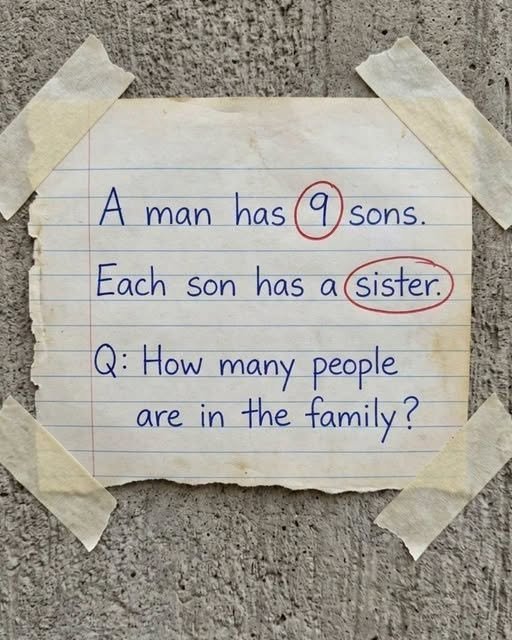
This riddle looks simple at first, but it tricks many people because of the way the sentence is written.
The question says:
“A man has 9 sons. Each son has a sister. How many people are in the family?”
Most people quickly think:
“Okay, 9 sons. Each son has a sister. That means every son has one separate sister.”
So they might answer:
9 sons + 9 sisters + 1 father = 19 people
But that is not correct.
The trick is in the phrase:
“Each son has a sister.”
It does not say each son has a different sister.
It simply says each son has a sister.
That means all 9 sons can share the same sister.
So the family includes:
1 father
9 sons
1 daughter/sister
That makes the answer:
11 people
But there is one more thing to think about.
The riddle only mentions a man, his 9 sons, and their sister. It does not mention the mother. So based only on the information given, the answer is 11.
However, if someone assumes the mother is also part of the family, then the answer could be 12.
But for the classic riddle answer, we only count the people directly mentioned or logically required by the sentence:
The man + 9 sons + 1 shared sister = 11 people.
Final Answer:
11 people in the family.
Moral/Lesson:
Sometimes the answer is not difficult — we just overthink the wording. This riddle teaches us to read carefully before jumping to conclusions.