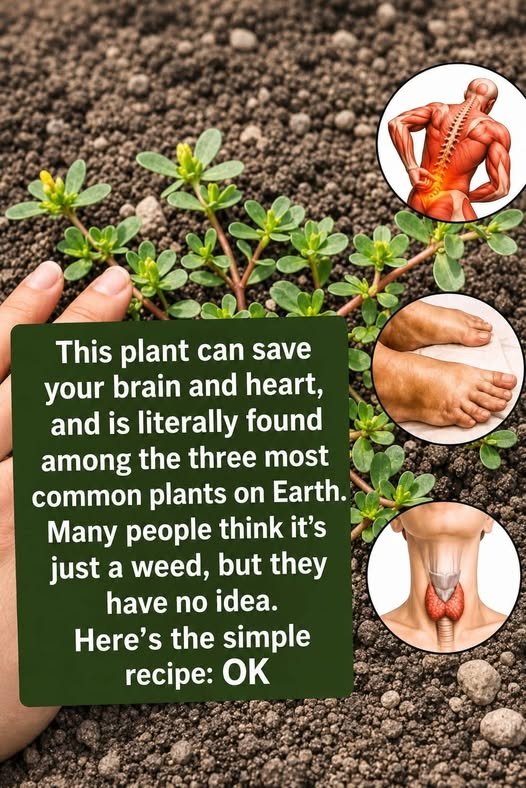
What if I told you that one of the most powerful plants in the world might be growing right under your feet?
You may have seen it in your garden.
Between cracks in the sidewalk.
Near farmland.
Along pathways.
Or spreading quietly across dry soil like an ordinary weed.
Most people pull it out and throw it away.
But in many cultures, this plant has been eaten for centuries.
It is called purslane.
Its scientific name is Portulaca oleracea.
And while some viral posts make huge claims about it — saying it can “save your brain and heart” or cure many health problems — the real story is more interesting.
Because purslane is not magic.
It is not a miracle cure.
But it is a highly nutritious edible plant that contains omega-3 fatty acids, antioxidants, vitamins, and minerals. Research describes purslane as a promising plant source of nutrition, omega-3 fatty acids, and antioxidant compounds.
So today, let’s talk about what this plant really is, why people call it powerful, how it may support health, and the important warnings you must know before eating it.
This video is for education only. It is not medical advice. Do not use wild plants as treatment for any disease without speaking to a healthcare professional.
Part 1: What Is This Plant?
The plant in the image appears to be purslane, also known as common purslane, pigweed, or little hogweed.
It usually grows low to the ground.
It has small, smooth, oval-shaped leaves.
The stems are often reddish or pinkish.
The leaves can look slightly thick or juicy because purslane is a succulent plant, meaning it stores water.
That is one reason it survives in hot, dry places where other plants struggle.
Purslane grows in many parts of the world and is often treated as a weed. But in many regions, it is also used as food. Reviews describe Portulaca oleracea as a warm-climate annual plant with a wide global distribution, commonly known as purslane in the United States and Australia.
So the first surprise is this:
Many people are not looking at a useless weed.
They are looking at an edible green.
Part 2: Why Do People Call Purslane Powerful?
People call purslane powerful because it is unusually rich for such a common plant.
It contains important nutrients such as:
Omega-3 fatty acids.
Vitamin C.
Vitamin E.
Beta-carotene.
Magnesium.
Potassium.
Antioxidants.
Plant compounds that may support overall health.
One older scientific study found that purslane contains omega-3 fatty acids and antioxidants including alpha-tocopherol, ascorbic acid, beta-carotene, and glutathione, and described it as a nutritious food rich in omega-3 fatty acids and antioxidants.
That is why purslane gets so much attention.
Most leafy greens are not known for omega-3 content.
But purslane contains alpha-linolenic acid, also called ALA, which is a plant-based omega-3 fatty acid.
Omega-3 fats are important because they are linked with heart and brain health as part of a balanced diet.
But remember: eating purslane alone will not “save” the brain or heart by itself. Health depends on your full diet, activity, sleep, medical care, genetics, and lifestyle.
Part 3: Can Purslane Help the Heart?
This is one of the biggest claims online.
People say purslane can protect the heart.
Here is the balanced truth.
Purslane contains plant-based omega-3 fatty acids and antioxidants. These nutrients are commonly associated with heart-supportive eating patterns.
A diet rich in vegetables, fiber, healthy fats, and antioxidants can support cardiovascular health.
So purslane may be a heart-friendly food.
But it should not be presented as a cure for heart disease.
It cannot replace blood pressure medicine.
It cannot replace cholesterol medication.
It cannot reverse blocked arteries by itself.
It cannot replace emergency medical care.
A better way to say it is:
Purslane may support heart health as part of a healthy diet because it provides omega-3 fatty acids, antioxidants, and minerals.
That is truthful.
That is safer.
And that is still powerful.
Part 4: Can Purslane Help the Brain?
The brain needs healthy fats, vitamins, minerals, and antioxidants.
Since purslane contains omega-3 fatty acids and antioxidant compounds, people often connect it with brain health.
But again, be careful with exaggerated claims.
There is no strong proof that eating purslane alone prevents dementia, cures memory loss, or protects the brain from every disease.
What we can say is:
Purslane contains nutrients that are useful in a brain-supportive diet.
Plant-based omega-3s, antioxidants, and vitamins can be part of an overall eating pattern that supports long-term health.
So instead of saying, “This plant saves your brain,” say:
This plant contains nutrients that may support brain health when included in a balanced diet.
That is the kind of message people can trust.
Part 5: Why It May Help With Inflammation and Oxidative Stress
A lot of chronic health problems are connected with oxidative stress and inflammation.
Oxidative stress happens when the body has too many unstable molecules called free radicals and not enough antioxidants to balance them.
Purslane contains antioxidant compounds.
That is why researchers are interested in it.
A review of purslane’s phytochemistry and pharmacological effects notes that the plant provides nutritional benefits because of its omega-3 fatty acids and antioxidant properties.
But again, antioxidants from one food are not a cure-all.
They are part of a bigger pattern.
Eating purslane with other vegetables, fruits, beans, nuts, seeds, whole grains, and healthy proteins is more useful than depending on one “super plant.”
Part 6: Can Purslane Help With Blood Sugar?
Some online posts claim purslane helps diabetes.
There is some research interest here, but people must be careful.
Some studies have looked at purslane seed or extracts in relation to blood sugar and metabolism. But this does not mean people should stop diabetes medication and eat purslane instead.
Diabetes is serious.
Blood sugar problems need proper testing and medical care.
So the safe message is:
Purslane may be a nutritious food for many people, but if you have diabetes, use it as food — not as a replacement for medication or a doctor’s plan.
This is very important.
Natural does not always mean safe for every person.
And healthy food does not automatically replace medical treatment.
Part 7: How Do People Eat Purslane?
Purslane has a slightly tangy, lemony, salty flavor.
The leaves and tender stems are commonly eaten.
People use it in:
Salads.
Soups.
Stews.
Stir-fries.
Omelets.
Yogurt dips.
Sandwiches.
Green smoothies.
Vegetable side dishes.
In some countries, purslane is cooked like spinach.
In others, it is eaten raw in salads.
A simple recipe could be:
Wash fresh purslane very well.
Remove tough stems.
Chop the leaves and tender stems.
Mix with cucumber, tomato, onion, lemon juice, olive oil, and a little salt.
You can also lightly sauté it with garlic and olive oil.
But there is one rule:
Never eat a wild plant unless you are 100% sure you identified it correctly.
Some plants can look similar to edible plants but may be unsafe.
Part 8: Important Safety Warning
This part is extremely important.
Purslane can be healthy, but it is not for everyone.
Purslane contains oxalates. WebMD notes that purslane contains oxalates, which have been linked to kidney stones.
That means people who are prone to kidney stones, especially calcium oxalate stones, should be careful.
People with kidney disease should speak with a doctor before eating large amounts.
Pregnant women, breastfeeding women, people on medication, and people with chronic illness should also ask a healthcare provider before using purslane medicinally.
Also, do not eat purslane from areas sprayed with pesticides, herbicides, road chemicals, or contaminated water.
Do not collect it from roadsides, industrial areas, pet waste areas, or polluted soil.
And wash it thoroughly before eating.
Part 9: The Biggest Mistake People Make With “Powerful Plants”
The biggest mistake is turning a nutritious food into a miracle cure.
That is how misinformation spreads.
One person says, “This plant has omega-3.”
Then another says, “This plant heals the heart.”
Then another says, “This plant cures disease.”
And suddenly, a healthy edible weed becomes a magical solution.
That is not how health works.
Purslane is valuable because it is simple, affordable, nutritious, and widely available.
But it does not cancel the need for doctors.
It does not replace medicine.
It does not fix years of unhealthy habits overnight.
It is one helpful food, not the whole answer.
Part 10: Why This Plant Still Deserves Respect
Even with all the warnings, purslane deserves respect.
Because many people walk past it every day without knowing it has nutritional value.
It is a reminder that nature often hides useful things in ordinary places.
A plant does not need to be expensive to be valuable.
It does not need fancy packaging.
It does not need to be sold as a supplement.
Sometimes the thing people call a weed is only called a weed because they do not know what it is.
Researchers describe purslane as a widespread weed with high nutritional value, especially because of its omega-3 fatty acid content.
That makes purslane an amazing example of overlooked nutrition.
Closing Message:
So, is purslane the most powerful plant in the world?
That may be an exaggeration.
But is it one of the most underrated edible weeds?
Absolutely.
It is rich in nutrients.
It contains plant-based omega-3 fatty acids.
It provides antioxidants.
It has been used as food in many cultures.
And it reminds us not to judge something as worthless just because it grows close to the ground.
But remember:
Identify it correctly.
Wash it well.
Avoid contaminated areas.
Be careful if you have kidney stone risk.
Do not use it as a replacement for medical treatment.
And if you have health conditions, ask a doctor before using it regularly.
The truth is simple:
Purslane is not magic.
But it is proof that sometimes, the plant people ignore may be more valuable than they ever imagined.